
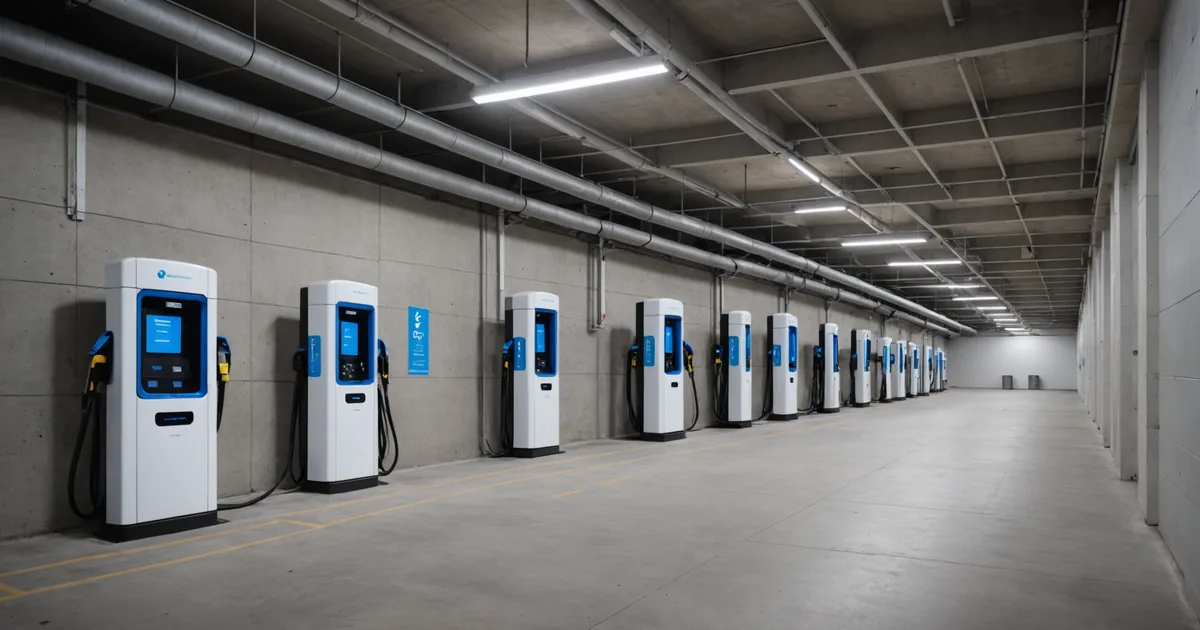
The instinct when planning EV charging for a 50-van depot is to count the vans and match them with chargers. That ratio might work if every vehicle arrived empty and departed full on a rigid schedule. In practice, delivery vans return with varying states of charge, at different times, and leave on different morning shifts. Getting the sizing wrong in either direction costs money: too few chargers and you are scrambling to move vehicles between bays each morning, too many and you have overspent on hardware that strains your grid connection unnecessarily.
Start With Energy Throughput, Not Charger Count
A more useful first question than "how many chargers do I need?" is this: how many kilowatt-hours do your vans need delivered each night?
For a 50-van depot running urban delivery routes, each vehicle typically returns with 40 to 60 percent state of charge. If you are running Renault Master E-Tech or Mercedes eSprinter class vehicles with usable battery capacities between 52 and 84 kWh, each van needs somewhere between 25 and 50 kWh to reach a full charge before the morning shift. Across 50 vehicles, your daily throughput requirement lands in the range of 1,250 to 2,500 kWh.
That number, divided by your available overnight window, tells you the average power draw you need to sustain. If vans return at 18:00 and the last shift departs at 07:00, you have 13 hours. Delivering 2,000 kWh in 13 hours requires sustaining an average of roughly 154 kW. That figure drives your grid connection requirement far more directly than the count of charger units.
How Dwell Time Shapes the Right Charger Power Level
Once you know your energy throughput and available window, charger power level selection becomes straightforward.
A 7.4 kW single-phase charger can deliver 96 kWh in a 13-hour window. For a van needing 35 kWh topped up, that is completely adequate with several hours to spare. An 11 kW three-phase charger delivers 143 kWh in the same window. A 22 kW three-phase unit delivers 286 kWh, which is more than double what any current delivery van can accept overnight from AC charging.
This matters because the incremental cost of moving from 11 kW to 22 kW is not just the hardware. Three-phase 22 kW requires a Type 2 charger capable of 32 A per phase and, more critically, heavier cabling throughout the installation. For overnight depot charging where dwell times exceed 10 hours, the speed premium of 22 kW AC rarely translates into meaningful operational benefit. The vans simply cannot accept charge that fast when connected to AC.
The 11 kW tier hits a practical sweet spot for most Dutch logistics depots. It charges fast enough to handle split-shift operations where some vehicles return mid-day, while keeping cable and installation costs manageable.
Grid Connection Headroom: The Real Constraint
Most depot electrification projects run into their first hard constraint at the grid connection, not at the charger hardware. Dutch Distribution System Operators (Enexis, Liander, Stedin) specify transport capacity in kVA, and exceeding your contracted maximum triggers demand charges or, in congested urban areas, actual load curtailment.
For a 50-van depot, a realistic grid connection requirement falls between 200 and 350 kVA depending on existing site loads. The critical calculation here is not average demand but peak demand. If 35 chargers simultaneously draw 11 kW each, that is 385 kW of instantaneous load. Most standard industrial connections cannot sustain that.
The two paths forward are either sizing the grid connection for the peak load scenario, or using load management to ensure that peak never materializes. Connection upgrades to medium voltage typically cost between 80,000 and 200,000 euros depending on distance to the nearest substation, and waiting times in congested urban areas like Amsterdam or Rotterdam can now exceed two years. That makes load management not just an operational tool but a commercial necessity in many cases.
The Case for More Chargers at Lower Utilization
Counter-intuitively, installing more chargers often leads to better outcomes than installing fewer. Here is the underlying logic.
If you install exactly 25 chargers for 50 vans on the assumption that only half the fleet needs to charge simultaneously, you have created a brittle system. When 30 vans return needing significant charge on a cold January day when battery range dropped below expectations, your 25-charger setup cannot serve them all. Fleet managers start manually assigning vehicles to bays, some vans leave at 78 percent instead of 95 percent, and recovery time spills into the next morning.
If you instead install 40 chargers and accept that each one will run at lower average utilization, the load management software has far more flexibility. It can sequence charging across the full set of connected vehicles, hold lower-priority vehicles at reduced current when grid headroom is tight, and recover quickly when a late-returning vehicle needs an accelerated charge cycle.
More EVSE units do not necessarily increase peak grid demand if the load manager is limiting aggregate current. The scheduler sees the full picture: which vehicles are connected, what their current SoC is, when each one is scheduled to depart, and what the grid connection allows. Running 40 chargers at an average of 6 kW each produces a 240 kW aggregate load. Running 25 chargers at 11 kW each produces 275 kW with worse fleet coverage. More connections, better distributed, is almost always the right answer.
OCPP: The Non-Negotiable Integration Standard
Before any load management system can manage charger behavior, every charging unit needs to support OCPP. The Open Charge Point Protocol is the communication standard that allows a central management system to set maximum current limits on individual connectors, read SoC and session data, and start or stop charging sessions remotely.
OCPP 1.6 is the current baseline for most commercial chargers. OCPP 2.0.1 adds significantly improved security and a more granular Smart Charging Profile that allows time-based current schedules. When evaluating charger hardware, confirm OCPP compliance and ask specifically which profiles are supported. Some manufacturers advertise OCPP support but implement it partially, which makes load management unreliable in edge cases.
We have worked through OCPP integrations with hardware from several major European suppliers. Compliance quality varies more than you might expect from the spec sheet. Testing a charger's OCPP implementation before committing to a large installation order is worth the time investment. A full commissioning test should include sending current limit overrides and verifying that the charger actually responds within the specified interval.
A Worked Scenario for 50 Vans
Consider a depot where 50 vans return between 17:30 and 20:00, with departures starting at 06:00. Each vehicle needs an average of 38 kWh to reach 95 percent charge. Total throughput requirement: 1,900 kWh. Available charging window: roughly 10 hours for the first-departing vehicles, up to 14 hours for vehicles that return early and leave with a later shift.
With a 200 kVA grid connection shared with existing depot loads consuming around 60 kW on average during evening hours, you have roughly 140 kW of sustained headroom for charging. At 140 kW sustained over 10 hours, that delivers 1,400 kWh, which is short of the 1,900 kWh target if all 50 vehicles need a full charge. The gap gets covered by shifting some charging into the 01:00 to 05:00 window, when both tariff rates and other site loads drop.
The answer in this scenario is typically 36 chargers at 11 kW each, a 220 to 250 kVA grid connection, and a load management system that sequences vehicles through two roughly equal charging waves. Decade Energy builds exactly this kind of schedule: the first wave handles vehicles returning in the evening at moderate current, the second wave runs at higher current during the cheapest overnight hours and catches any vehicles that returned late or needed less initial charge than expected.
We are not saying you should cut charger count to the minimum and trust software to compensate for it. Software scheduling improves efficiency substantially, but physical headroom in charger count provides resilience when vehicles return late, charging sessions fail, or a firmware update temporarily takes a unit offline. Build that buffer in from the start, and size it at 15 to 20 percent above the minimum throughput calculation.
What the Numbers Look Like at Different Scales
To make this concrete across different depot sizes, here is a rough sizing framework based on the overnight dwell time and throughput model:
For a 20-van depot with a 10-hour window and average 35 kWh per vehicle: total throughput requirement is 700 kWh, requiring a sustained average of 70 kW. Twelve to fourteen chargers at 11 kW with a 120 to 160 kVA grid connection typically covers this with appropriate headroom. For 50 vans as described above, 32 to 40 chargers with a 200 to 250 kVA connection. For 80 vans with mixed dwell times: the calculation becomes more sensitive to your specific departure time distribution, but 60 to 70 chargers at 11 kW with a 320 to 400 kVA connection is a reasonable starting point.
In each case, the load management system is not a bonus feature you add later. It is load management that makes these connection sizes work without requiring you to pay for a grid connection sized for an improbable worst-case simultaneous peak. Plan for it from the initial design, make sure your chosen charger hardware supports OCPP fully, and the infrastructure investment you make in year one will serve you through a fleet that is twice as large.
Ready to cut your depot energy bill?
See how Decade Energy's optimizer works with your fleet size and tariff contract.
Book a Demo