
The business case for fleet electrification looks different depending on which costs you include and which you leave out. A fleet manager who benchmarks an electric van against a diesel van on purchase price alone will reach a very different conclusion than one who runs the full five-year TCO, including charging infrastructure, electricity contracts, energy management, maintenance, and residual value.
This article works through the main TCO components for electric delivery vans in the Netherlands in 2026, using ranges that reflect actual market pricing. It is not a recommendation to electrify or not. It is a framework for building a calculation that is specific enough to be defensible when presenting to a finance team.
Vehicle acquisition cost
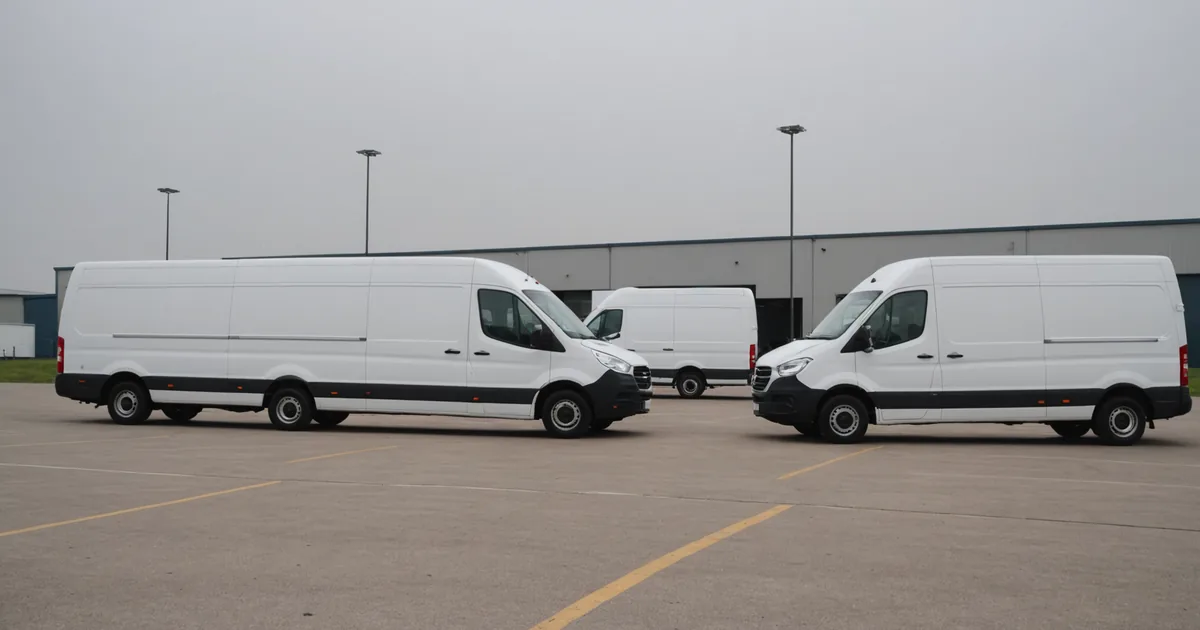
The most commonly operated electric van segments in Dutch logistics fleets are the medium van class (roughly 3.5 tonne GVM, 8-11 cubic meters cargo volume) and the larger panel van class (up to 3.5 tonne with extended wheelbase). In this segment in 2026, list prices for electric variants from established manufacturers range from approximately €38,000 to €58,000, depending on battery capacity (typically 55 to 90 kWh usable), payload configuration, and options.
Comparable diesel vans in the same segment typically list at €28,000 to €38,000, creating a purchase price premium for electric of roughly €10,000 to €20,000 per vehicle. This premium has narrowed from 2023-2024 levels as production volumes increased and battery costs continued to fall, but it has not yet disappeared at the medium-van scale.
Dutch fleet operators should also factor in the MIA/VAMIL fiscal incentives currently available for zero-emission commercial vehicles, which provide accelerated depreciation and investment deduction benefits. The exact value depends on your tax position, but these incentives can partially offset the acquisition premium for operators who use Dutch corporate tax structures. Check the current RVO.nl investment list, as category inclusions and percentages are reviewed annually.
Charging infrastructure cost
Charging infrastructure is where the TCO calculation gets more complex, because the cost per vehicle varies significantly with depot configuration and fleet size.
A 22 kW AC charger suitable for overnight depot charging costs approximately €800 to €1,800 per unit (hardware only) in 2026, depending on whether it includes cable management, smart charging capability (OCPP compliance), and brand. Installation per charger, including civil works, cabling from the distribution board, and commissioning, typically runs €600 to €2,500 depending on distance to the main supply and whether the building requires electrical upgrades.
For a depot adding 30 electric vans where one charger per parking bay is installed, the hardware and installation cost might run €50,000 to €90,000, or roughly €1,700 to €3,000 per vehicle. For a depot where smart scheduling means 20 chargers can handle 40 vehicles (because not all charge simultaneously), the per-vehicle infrastructure cost drops to €850 to €1,500.
This is one of the less obvious benefits of smart charging: it reduces the charger-to-vehicle ratio needed to achieve full fleet readiness, directly reducing capital cost. The chargers you do not have to buy because the schedule is optimized are real savings, not theoretical ones.
If the depot requires a grid connection upgrade to accommodate the additional load, this cost must also be attributed to the EV program. Grid connection upgrades in the Netherlands, for depots increasing from a 100-200 kW connection to 400-600 kW, can cost €30,000 to over €150,000 depending on required infrastructure work by the network operator. In congested areas, delays of 12-24 months are common as of 2025-2026, which may also have an opportunity cost if fleet electrification is delayed.
Electricity cost: the number that moves the most
Energy cost for electric vans depends on three things: consumption per km (typically 0.25 to 0.35 kWh/km for medium vans in urban duty cycles), annual km per vehicle, and the effective per-kWh cost including all contract components.
For a van covering 120 km per day over 240 operating days per year, annual consumption is approximately 7,200 to 10,000 kWh. At an effective electricity cost of €0.18 to €0.28 per kWh (including network tariffs, surcharges, and VAT on a typical Dutch commercial contract), annual electricity cost per vehicle runs €1,300 to €2,800.
Diesel comparison: the same van covering 29,000 km per year at 8 liters per 100 km consumes approximately 2,300 liters. At €1.55 to €1.75 per liter (commercial diesel in the Netherlands in early 2026), that is €3,600 to €4,000 per vehicle per year in fuel, not including AdBlue.
The energy cost advantage for electric is real and meaningful, typically €1,500 to €2,500 per vehicle per year in favor of electric under managed charging. But this advantage erodes significantly if charging is unmanaged and demand charges inflate the effective per-kWh cost. An operator whose depot demand charges push the all-in electricity cost to €0.35 or €0.40 per kWh may find the fuel cost advantage narrows considerably. This is why demand charge management is not a nice-to-have: it is directly in the TCO calculation.
Maintenance cost
Electric drivetrains have fewer moving parts and no combustion-related service requirements (no oil changes, no fuel filters, no timing belts, no exhaust system maintenance). Published fleet operator data from programs in the Netherlands and elsewhere in Europe consistently shows maintenance cost reductions of 25% to 45% per km for electric medium vans compared to diesel equivalents.
The main maintenance items for electric vans that have no diesel equivalent are tyre wear (which can be higher due to regenerative braking patterns and torque delivery characteristics), brake pad life (typically longer due to regenerative braking), and 12V auxiliary battery service (the small lead-acid battery that runs ancillaries when the main pack is offline). AC filter and cabin systems maintenance is similar to diesel.
For a fleet running 29,000 km per year, the maintenance saving is typically in the range of €800 to €1,500 per vehicle per year. Over a 5-year holding period, this represents €4,000 to €7,500 per vehicle, which is a meaningful contributor to closing the acquisition cost premium.
Energy management software
This cost category does not appear in most TCO templates written before fleet electrification became common, but it belongs in any honest calculation for depots with more than 10 to 15 electric vehicles.
Smart charging software for a fleet of 30 to 60 vehicles costs in the range of €150 to €700 per month depending on feature set, integration requirements, and whether multi-depot management is included. Over a 5-year period, this amounts to €9,000 to €42,000 total for a single depot.
The right question is not "does this cost belong in the TCO" but "what does it return?" For a 40-van depot, managing demand charges from €5,500 to €1,600 per month (a €3,900 monthly saving from the scenario described earlier in this piece) returns the software cost in the first month, many times over. For smaller depots where demand charges are lower and tariff windows shorter, the payback period is longer but usually still within 12 months for depots with more than 20 vehicles.
Residual value
Residual value projections for electric vans are less settled than for diesel, because the market for used electric commercial vehicles in the Netherlands is still maturing. The main risk factor is battery degradation: a used electric van with 80% remaining battery capacity (typical after 3-4 years of fleet use) has meaningfully shorter effective range, which affects resale value.
Battery health management during the operational period matters here. Consistently charging to 100% state of charge accelerates degradation slightly compared to charging to 80-85% for daily use. For fleet operators, the optimization between departure readiness (wanting high SoC) and battery longevity (preferring lower daily maximum SoC) is a real design question. Keeping target SoC at 90% rather than 100% for vehicles whose routes do not require it is a reasonable practice that may meaningfully extend battery life over a 5-year fleet holding period.
Current residual value estimates for 3-year-old electric medium vans in the Dutch market range broadly, but operators working with lease finance desks report haircuts in the 40-55% range, which is similar to or slightly worse than diesel equivalents at similar age. This gap is expected to narrow as the used EV market matures and battery health certification becomes standardized.
Putting it together: a directional 5-year number
A directional 5-year TCO comparison for a single medium-delivery-van in Dutch urban logistics:
Electric van, managed charging: Acquisition cost minus incentives (roughly €42,000 net), charging infrastructure share per vehicle (€2,000 to €3,500), energy management software share (€500 to €1,400 over 5 years), electricity cost (€7,000 to €12,500 over 5 years at managed rates), maintenance (€5,000 to €7,500 over 5 years), minus residual value (€18,000 to €22,000 estimate). Indicative total: €37,000 to €45,000.
Diesel van, same usage: Acquisition cost (roughly €32,000), no charging infrastructure, fuel cost (€18,000 to €20,000 over 5 years), maintenance (€9,000 to €14,000 over 5 years), minus residual value (€12,000 to €15,000 estimate). Indicative total: €42,000 to €51,000.
These ranges are wide because the inputs vary significantly by depot configuration, contract type, and usage pattern. They are not presented as precise calculations but as a directional framework. The key finding is that under managed charging with demand charge control, the 5-year TCO for electric can be competitive with or better than diesel for medium-van urban logistics in the Netherlands at 2026 pricing. Under unmanaged charging with high demand charges, the electric case deteriorates significantly.
The word "managed" in "managed charging" is doing a lot of work in this TCO. It is not a technical feature; it is the difference between a financially viable electrification program and one that costs more than the diesel fleet it replaced.
Ready to cut your depot energy bill?
See how Decade Energy's optimizer works with your fleet size and tariff contract.
Book a Demo