
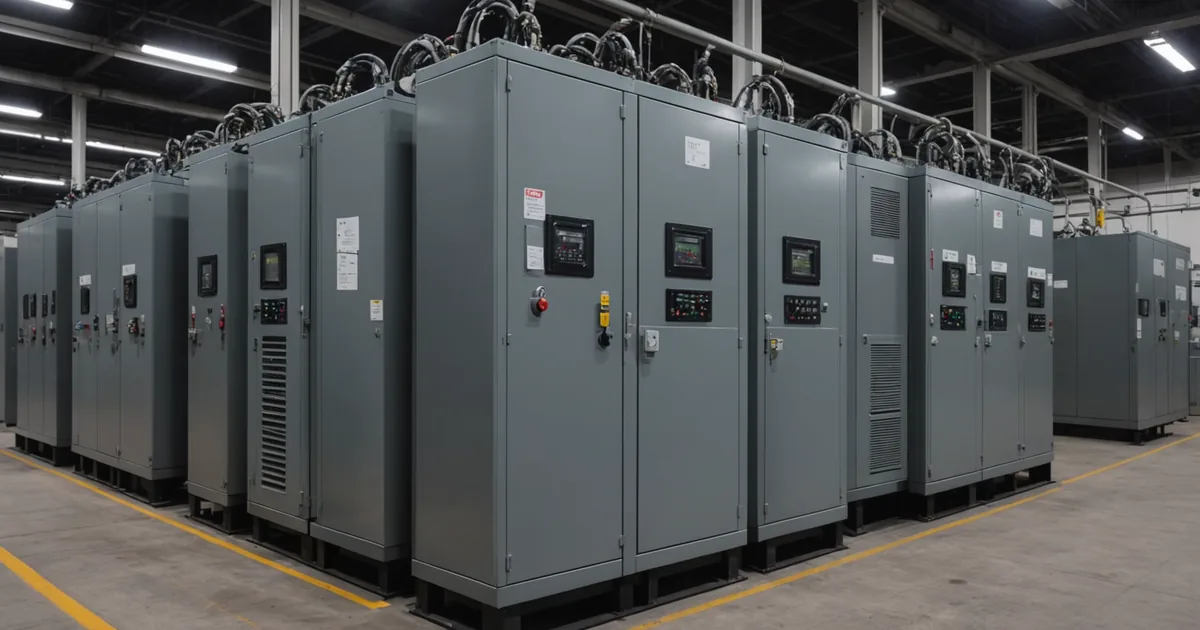
When a logistics operator decides to electrify a significant portion of their fleet, the assumption is usually that a grid connection upgrade is inevitable. The reasoning seems obvious: more vehicles mean more charging load, and more charging load means you need more grid capacity. In practice, that logic skips a critical variable: when the load actually occurs.
Most Dutch commercial electricity contracts specify a grid connection capacity in kVA. Your DSO (Enexis, Liander, or Stedin depending on your location) will not let you consistently draw more than that contracted maximum. Exceeding it can trigger automatic load shedding at the meter or, for older industrial connections, a demand charge that penalizes the highest 15-minute peak each billing period. The assumption when planning fleet electrification is therefore that you need enough contracted capacity to charge everything simultaneously.
But simultaneous charging is almost never what actually happens at a well-managed depot, and it is definitely not what should happen if you care about your electricity bill.
How Load Management Changes the Capacity Equation
Load management works by distributing the charging demand across the available time window and available grid headroom. Instead of 35 chargers all starting at full current when the evening fleet returns, the load manager keeps aggregate draw below a configured threshold. It does this by throttling individual chargers in real time, using OCPP to set maximum current limits on each connector.
The result is that your peak grid demand at any given moment stays within bounds, even while total vehicles connected is high. If your grid connection allows 150 kW for charging (after accounting for existing site loads), the load manager caps the fleet's aggregate draw at 145 kW regardless of how many vehicles are plugged in. It distributes that budget across connected vehicles based on their priorities, with vehicles departing earliest receiving more current.
This shifts the planning question from "how many kVA do I need to charge all my vans?" to "how many kWh can I push through my existing connection during the available overnight window?" Those often turn out to be very different numbers, and the second calculation is frequently more favorable than operators expect.
A Real Constraint: Congestion in the Dutch Grid
Grid connection upgrades in Netherlands are not just expensive, they are slow. Transmission congestion has been a documented problem in Noord-Holland and Utrecht provinces in particular, with network operators like Liander publishing formal capacity maps showing where no new large connections can be accommodated. For industrial sites in Amsterdam's Amstelkwartier and Schiphol-area logistics zones, waiting times for capacity upgrades routinely stretch to 12 to 24 months even for increases of 50 to 100 kVA.
For a fleet operator who wants to electrify 30 vans this year, a grid upgrade that arrives in 2027 is operationally useless. Load management using existing connection capacity is not just a cost optimization in these situations. It is the only path to actually running the vehicles you have already ordered.
This is one area where we hear directly from fleet managers in our early-access pilots. The grid timeline is the hard constraint, and it forces companies to be creative about how they use the capacity they already have. The typical finding is that an existing 160 to 200 kVA connection, shared with a depot that has general lighting and warehouse loads of around 40 to 60 kW, leaves a practical charging budget of 100 to 160 kW. With smart scheduling, that is enough to handle 30 to 40 vans overnight without any upgrade.
Where Load Management Applies and Where It Does Not
We should be clear about what load management can and cannot do here. If your depot has a 63 kVA connection and you are trying to charge 50 large vans overnight, no amount of intelligent scheduling will substitute for more grid capacity. The physics of energy throughput cannot be bypassed. What load management prevents is the scenario where you need, say, 180 kVA for a 40-van depot but your DSO can deliver 250 kVA within 3 months at reasonable cost, so you overshoot and contract for 300 kVA to avoid ever revisiting the question.
In the middle ground, where your existing connection is close to sufficient but you assumed it was not, load management closes the gap. The common pattern we see is an operator who calculated required capacity by multiplying charger count by charger power rating and arrived at a frightening number. A 32-charger installation at 11 kW per unit produces 352 kW at theoretical maximum. Very few existing industrial connections can sustain that. But theoretical maximum is never what the load manager allows to happen.
The Financial Case Against Upgrading
A grid connection upgrade for a commercial site typically involves three separate cost components: the DSO connection fee, the civil works to trench cables from the distribution substation to your meter panel, and the internal electrical works to upgrade switchgear and distribution boards inside your facility. Together, these run between 60,000 and 250,000 euros depending on distance to the nearest substation capable of additional capacity, site-specific groundworks, and the scale of internal upgrades needed.
Against that, load management software at the fleet scale costs roughly 5,000 to 15,000 euros per year in total (software subscription plus appropriate hardware monitoring infrastructure). Over a five-year period, you are comparing a one-time infrastructure spend in the range of 100,000 to 200,000 euros against a recurring software cost of perhaps 50,000 to 75,000 euros cumulative. The software also delivers ongoing operational savings through tariff optimization, so the net cost comparison shifts further.
The boundary condition where upgrade wins: if you need to increase contracted capacity anyway for operational reasons unrelated to EV charging (warehouse expansion, refrigeration additions, new machinery), bundling that upgrade is sensible. A standalone upgrade justified purely by fleet electrification is harder to defend when the throughput math shows your existing connection can handle the load with intelligent scheduling.
How to Run the Calculation Yourself
Before assuming you need an upgrade, work through this sequence. First, check your current contracted transport capacity in your electricity agreement and note the monthly peaks recorded over the past 12 months (your supplier or DSO can provide this). Second, estimate your non-EV base load during overnight hours, typically measured as average kW between 22:00 and 06:00. Third, subtract the base load from your contracted maximum to find your EV charging headroom.
Fourth, calculate your nightly energy throughput requirement: number of vans multiplied by average kWh needed per charge cycle. Divide that by your available overnight window (usually 8 to 12 hours). The result is the average kW you need to sustain. If your charging headroom from step three exceeds this average requirement, load management can almost certainly handle your fleet on the existing connection.
If charging headroom is only slightly below the average requirement, look at whether you can shift some charging into the very early morning hours (01:00 to 05:00). During those hours, both grid tariff rates and site base loads are typically at their minimum, and the full contracted capacity is available for charging. Most depot schedules have flexibility here, since the first departures are rarely before 06:00.
Integration with Your DSO's Congestion Management
Dutch DSOs have been rolling out grid congestion management programs that allow large flexible loads to participate in demand response schemes. Under these programs, industrial customers who can signal their willingness to curtail load during peak network periods can receive connection priority or tariff credits in return.
Fleet charging loads are well-suited to this because the flexibility is genuine: if the grid operator needs you to reduce load between 18:00 and 20:00 on a cold January evening, a depot charging optimizer can delay the first charging wave without compromising morning departure readiness. The vans simply charge later in the night instead.
Participating in congestion management schemes requires a load management system that can accept external curtailment signals and translate them into charger-level current adjustments. This is a capability we have built into our scheduling architecture specifically because we saw how important it would become as Dutch DSOs expand their flexibility markets. It does not change the fundamental sizing analysis, but it does mean that operators who invest in smart charging infrastructure now are better positioned to benefit from grid service revenue as those programs mature.
Ready to cut your depot energy bill?
See how Decade Energy's optimizer works with your fleet size and tariff contract.
Book a Demo